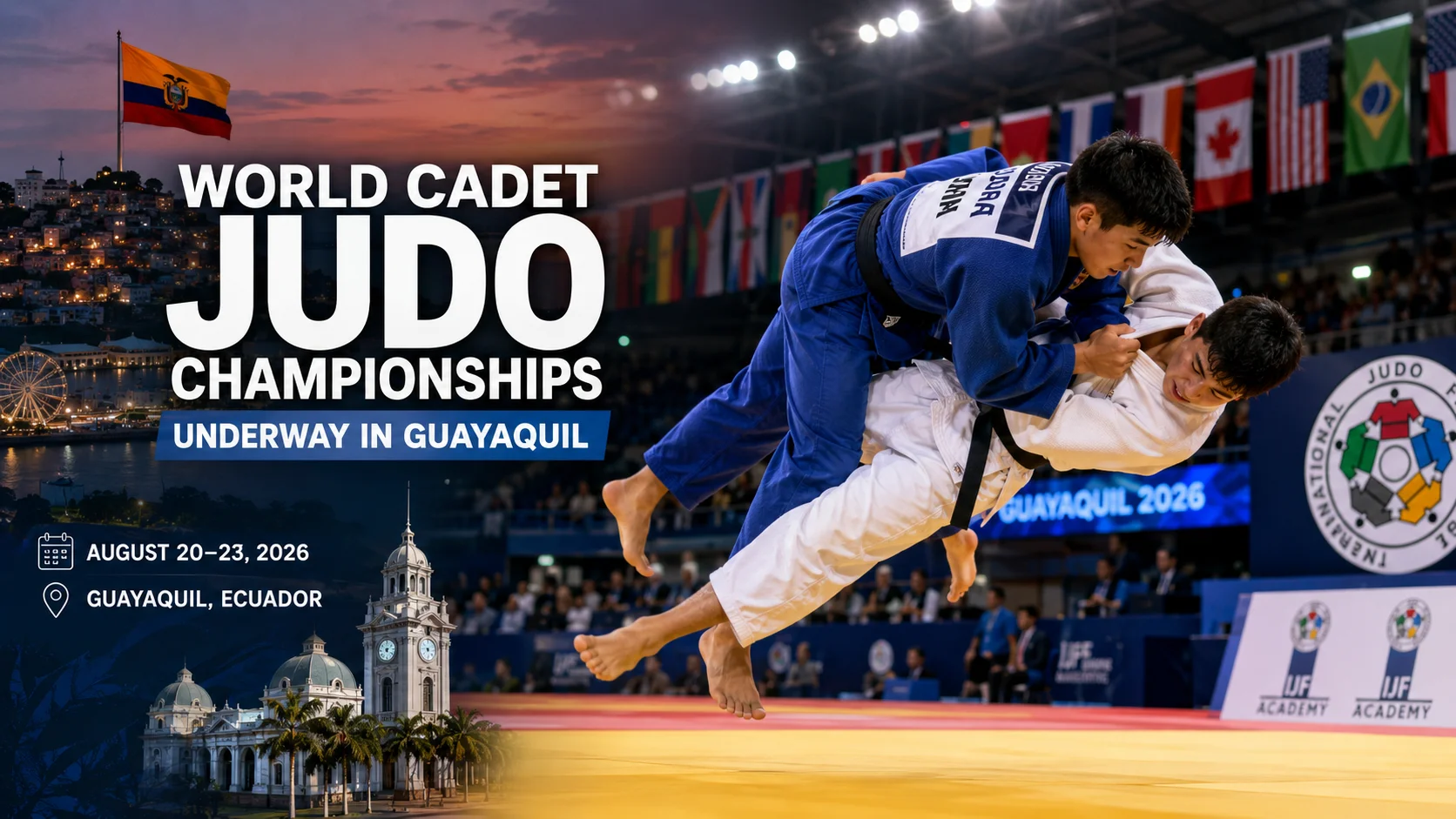
A Record Turnout in Ecuador
This year's championships have drawn 457 competitors from 59 countries across five continents, split almost evenly between 245 men and 212 women. That scale puts Guayaquil 2026 among the largest editions in the event's history, which dates back to its inaugural staging in Budapest in 2009. Athletes are competing across eight weight categories per gender, ranging from -50kg to +90kg for men and -40kg to +70kg for women, with a mixed team event closing out the competition on August 23.
For context, the World Cadet Championships sit at the top of international judo for athletes 18 and under, making this the most important stage most of these competitors have ever stepped onto. Many will go on to junior and senior World Championships in the years ahead, so performances in Guayaquil often serve as an early signal of who to watch next.
Day One and Two Highlights
The opening days of competition have already produced standout performances and a few genuine upsets.
American judoka Sebastian Teran delivered one of the tournament's headline moments, capturing gold in the men's -55kg division. The 16-year-old, who entered as the world number one and top seed in his category, worked through a tough draw with wins over opponents from Argentina, Azerbaijan, and Russia before sealing the title in the final. His win made him only the second Cadet World Champion in USA Judo's history, following Jonathan Yang's title in 2024.
Europe made its presence felt on day two, claiming two gold medals and nine podium finishes in total. Poland's Jagoda Ciupek, the top seed at -57kg, needed barely 90 seconds to win her final, using three attacks with o-uchi-gari to overwhelm Kazakhstan's Inzhu Zhumazhan and claim the title.
Germany's Jolina Reinhold produced the other big story of the day at -63kg. She entered unseeded but had already shown her pedigree with a 2024 cadet world medal and a 2025 European Youth Olympic Festival title. After the category's presumed favorite, Slovenia's Ilariia Tsurkan, was upset in the quarter-finals by Japan's Aki Asada, Reinhold beat Asada in the semi-final and then dispatched Austria's Bleona Rama in the final with a koshi-guruma throw followed by a fast ne-waza finish. Speaking afterward, Reinhold described the emotional weight of the moment, saying she only realized what she had achieved once she stood up and saw the championship signage, and that the win reflected months of nervous, dedicated preparation.
Elsewhere on day two, Ukraine's Kseniia Kyrylchuk pulled off one of the tournament's biggest surprises, eliminating defending champion Rio Shirakane of Japan in the -52kg semi-final before taking silver. In the men's -73kg final, unseeded Japanese judoka Genki Fujinaka countered Georgia's Giorgi Mtchedlishvili for an ippon win, denying Georgia what looked like a near-certain title.
Europe's Strong Continental Showing
Beyond the two day-two gold medals, Europe's depth showed up throughout the results sheet. Ukraine's Kyrylchuk defeated opponents from Panama, Poland, and Ecuador on her way to silver at -52kg, while Portugal's Sofia Gaspar edged Israel's Yali Yahav in a tightly fought bronze-medal contest in the same category. Georgia added a second silver through Giorgi Kapanadze at -66kg after upsetting the category's second seed, only to fall to Canada's Anes Mati in the final. Israel's Tom Simkhaev capitalized on a desperate late push from Georgia's Giorgi Avaliani, countering for ippon to claim bronze in the same weight class.
That density of results across multiple countries and weight categories is part of what makes the World Cadet Championships such a useful barometer. It isn't just about who wins gold — the spread of medals across Poland, Germany, Ukraine, Portugal, Georgia, Israel, Japan, Kazakhstan, Canada, and the United States through the tournament's opening days shows how widely competitive cadet judo has become at the international level.
Why This Tournament Matters
Cadet-level competition doesn't always draw mainstream sports attention, but it plays an outsized role in shaping the sport's future. Names crowned in Guayaquil this week — Ciupek, Reinhold, Teran, Fujinaka, and others — are the athletes national federations will be tracking closely as they progress toward junior and senior competition. Several of this year's medalists, including Reinhold, have already spoken about targeting Olympic qualification down the road, underlining how closely cadet success is tied to long-term development pathways.
The event also reflects judo's genuine global reach. With 59 countries represented, the tournament isn't dominated by a single region, even though Europe's medal count through two days shows the continent's development systems remain formidable. Strong showings from Japan, Georgia, Kazakhstan, and the United States point to a competitive landscape that extends well beyond the sport's traditional powerhouses.
What's Next on the Judo Calendar
The mixed team event wraps up the Guayaquil championships on August 23, capping off the individual competition that began the tournament. From there, the international judo calendar shifts toward its senior showcase: the World Judo Championships in Baku, Azerbaijan, running October 4-11, followed by the Junior World Championships in Tashkent, Uzbekistan, in November.
For now, though, all eyes remain on Guayaquil, where a new generation of judoka is making its case on the sport's biggest cadet stage.
Be the first to comment!