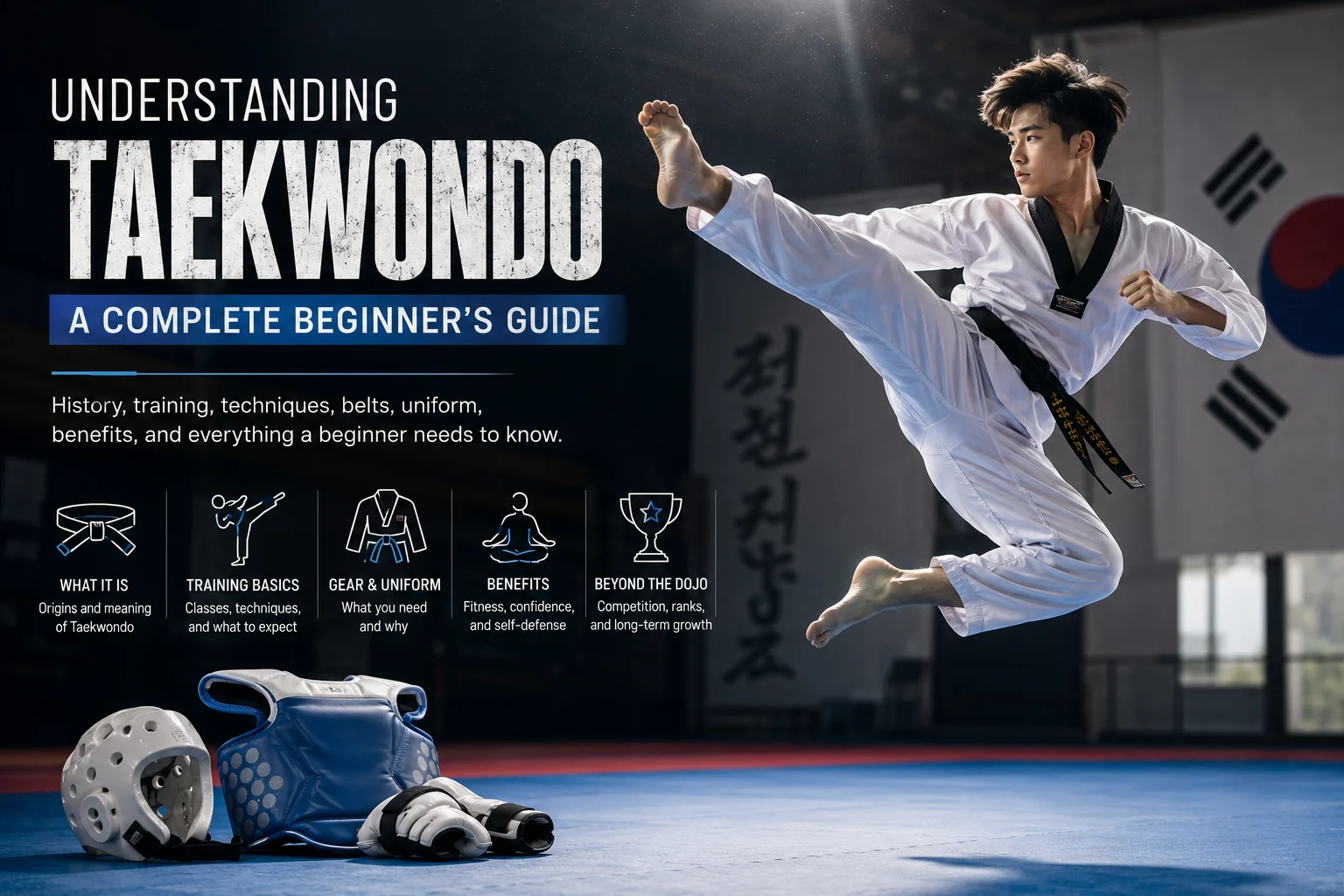
This guide breaks down what Taekwondo actually is, where it came from, how training works, and what a beginner needs to know before stepping onto the mat.
What Is Taekwondo?
Taekwondo is a Korean martial art built around striking — primarily kicking, but also punching, blocking, and open-hand techniques. It's practiced both as a traditional self-defense system and as a competitive sport, and since 2000 it has been an official Olympic event. What sets it apart is its heavy emphasis on kicks, including fast, high, and spinning techniques unusual in most other combat sports.
what does taekwondo mean
The word breaks into three parts: "tae" (foot), "kwon" (fist), and "do" (way or path) — together, "the way of the foot and fist." That name captures the art's identity well: a striking system that treats kicking and hand techniques as essential, while framing training as a long-term discipline rather than just a set of fighting moves.
how do you spell taekwondo
The standard English spelling recognized by World Taekwondo and most governing bodies is "taekwondo," written as one word. You'll sometimes see "Tae Kwon Do" or "Taekwon-Do," especially from older schools or organizations tied to the International Taekwon-Do Federation (ITF), but "taekwondo" is the most widely used spelling today.
The Origins and History of Taekwondo
Taekwondo's history is more layered than many beginner guides let on. It isn't accurate to say it either appeared out of nowhere or that it's a direct, unbroken continuation of ancient Korean fighting arts. The real story sits somewhere in between.
is taekwondo korean
Yes, taekwondo is a Korean martial art. Its formal development took place in Korea, and its major governing organizations — the Kukkiwon and World Taekwondo — are both based in Seoul. That said, historians generally agree modern taekwondo also drew influence from Okinawan and Japanese karate, widely practiced in Korea during the Japanese occupation in the early 20th century. Korea's own older combat traditions, including subak and taekkyeon, are often cited as cultural influences, but taekwondo as it's known today was formalized well after those older systems existed.
when was taekwondo invented
There isn't a single clean date, and that's part of the real story rather than a gap in the research. After Korea's liberation in 1945, several martial arts schools known as kwans opened around the country, each teaching a style rooted in a mix of Korean tradition and imported karate. Through the 1950s, Korean military and political leaders pushed to unify these schools under one name and curriculum. The name "taekwondo" was formally adopted in 1955, and the Korea Taekwondo Association was established in 1959, later consolidating in 1961. The Kukkiwon opened in 1972 as the sport's central headquarters, and the World Taekwondo Federation (now World Taekwondo) was founded in 1973 to govern competition internationally. Taekwondo's identity was built gradually across roughly two decades, not invented on one date.
Taekwondo Training for Beginners
A typical beginner class follows a fairly consistent structure, regardless of which school or organization runs it:
- Warm-ups — stretching and light cardio to prepare for kicking
- Basic stances and footwork — foundational positioning and movement used in nearly every technique
- Kicks — front kick, roundhouse kick, side kick, and back kick, typically taught first
- Punches and hand strikes — straight punches and basic blocking
- Forms (poomsae) — pre-set movement patterns practiced solo to build muscle memory
- Sparring — controlled, protective-gear practice, usually introduced once fundamentals are solid
- Conditioning and etiquette — strength and flexibility work alongside bowing and respect toward instructors
Beginners are rarely thrown into full-contact sparring right away. Most schools spend the first several weeks building fundamentals before introducing partner drills.
Taekwondo Belts and Ranking System
Belt color is the most visible way taekwondo tracks progress, but belt systems aren't universal. Different organizations and even individual schools use different color sequences, testing requirements, and terminology.
how many belts in taekwondo
Most schools use somewhere between eight and ten color belt ranks before black belt, though the exact number and order varies. A common structure includes white, yellow, green, blue, red, and black, sometimes with additional stripe or "half-step" belts added between the main colors.
how many belts are there in taekwondo
Using that same range, most systems land around 9 to 12 total ranks when counting sub-belts, from white belt through first-degree black belt. Because there's no single global standard, the count depends on which organization or school a student trains with — Kukkiwon-affiliated schools, ITF schools, and independent regional associations don't all follow the same structure.
| Rank Range | Typical Color | Common Focus |
|---|---|---|
| Beginner | White | Stances, etiquette |
| Early intermediate | Yellow / Orange | Fundamental kicks, blocks |
| Mid-level | Green / Blue | Combinations, forms |
| Advanced color belt | Red / Brown | Sparring strategy |
| Black belt | Black | 1st Dan and beyond |

how long it takes to get black belt in taekwondo
For most students training consistently — typically two to three classes per week — reaching first-degree black belt tends to take between three and five years. The timeline depends on several factors:
- Training frequency and consistency
- The school's promotion requirements and testing intervals
- Student age (children's programs often move more gradually)
- Physical and technical skill development
- Whether the organization requires minimum time spent at each rank
Schools that test every few months on a fixed schedule tend to produce faster progressions than schools with stricter time-in-rank requirements. Neither approach is inherently better — it depends on the school's philosophy.
how many degrees of black belt are there in taekwondo
Black belt isn't a single endpoint — it's the start of a "Dan" grade system that continues progressing. Most organizations recognize ranks from 1st Dan up through 9th Dan, though not every governing body caps it at the same number, and some reserve the highest Dan grades for honorary recognition rather than testing. Exact requirements and total Dan levels vary by federation, so there's no single universal number that applies worldwide.
How to Tie and Wear a Taekwondo Belt
how to tie the belt in taekwondo
Tying a taekwondo belt properly is one of the first practical skills new students learn. Here's a simple beginner-friendly method:
- Find the center of the belt and place it against your stomach, with equal length hanging on both sides.
- Wrap both ends around your back and cross them behind you.
- Bring both ends back around to the front.
- Cross the right end over the left end, then tuck it underneath both layers of belt wrapped around your waist and pull it through.
- Take the same end and cross it over the other end again, forming a loop.
- Tuck that end through the loop you just created and pull both ends tight to form a flat, secure knot.
- Adjust the belt so both ends hang evenly and the knot sits centered at the front.
It takes most beginners a few tries to get comfortable with this, and it's normal to need help from an instructor during the first couple of classes.
Taekwondo Uniform and Equipment
what is a taekwondo uniform called
The uniform worn in taekwondo is called a "dobok." It typically consists of a lightweight jacket and matching pants, usually white for beginner and intermediate students, though some schools use black uniforms for advanced students. The dobok is designed to allow full range of motion for high kicks while remaining durable for regular training.
Basic beginner equipment typically includes a dobok, a belt, a mouthguard, and sparring gear such as head protection, a chest protector (called a "hogu"), and forearm, shin, hand, and foot padding. Not every beginner needs full sparring gear on day one — most schools guide students on what to purchase and when, since protective equipment usually isn't required until partner sparring begins.
what happens if you drop your mouthguard in taekwondo
In a regular class, dropping a mouthguard is a minor, harmless interruption — the student picks it up, wipes it off if needed, and puts it back in before continuing, while the instructor briefly pauses the drill for hygiene and safety. In formal competition, rules vary by tournament and governing body, but referees typically stop the match briefly so the athlete can retrieve and reinsert the mouthguard before action resumes, since continuing without one is a safety risk. It's routine and nothing beginners should worry about.
Taekwondo Techniques and Competition
Once fundamentals are solid, students build toward more dynamic techniques and eventually competition. Core areas include kicking techniques (roundhouse, side, back, hook, and spinning kicks — taekwondo's signature moves), punches (more limited than in some other striking arts, since scoring heavily favors kicks), defensive footwork and distance management, forms (poomsae) as both a training method and their own competitive category, and sparring (gyeorugi) — the Olympic format, scored using electronic sensors in the hogu and headgear that register the force and legality of strikes.
Competition taekwondo and training-hall taekwondo aren't identical. Olympic-style sparring rules restrict certain techniques and emphasize scoring zones, while everyday class training covers a broader range of self-defense-oriented movement that wouldn't necessarily score in a competition ring.
Taekwondo vs Other Martial Arts
what is the difference between karate and taekwondo
Taekwondo and karate share historical roots — taekwondo's early development was influenced by Okinawan and Japanese karate — but the two arts have diverged significantly.
| Feature | Taekwondo | Karate |
|---|---|---|
| Origins | Korea, formalized mid-20th century | Okinawa/Japan, older lineage |
| Main emphasis | Kicking, especially high and spinning kicks | Balanced striking, strong hand technique |
| Kicking | Extensive, fast, high-target | Present but less central |
| Hand techniques | Secondary to kicks in competition | Central to training and scoring |
| Competition | Olympic sparring, electronic scoring gear | Styles vary — point sparring or full-contact |
| Training approach | Poomsae (forms) alongside sparring | Kata alongside kumite |
Neither art is objectively "better" — they emphasize different tools and competitive formats, and the right choice comes down to a student's personal goals and what a local school offers.
is hapkido better than taekwondo
This comes down to what a student is looking for rather than one art being superior. Hapkido places heavier emphasis on joint locks, throws, and redirecting an opponent's force, with kicks and strikes playing a supporting role. Taekwondo centers on striking, particularly kicking, with far less focus on grappling.
Students primarily interested in dynamic striking, competitive sparring, and an Olympic sport pathway tend to gravitate toward taekwondo. Students more interested in close-range self-defense and control techniques often find hapkido a better fit. Many practitioners eventually train in both, since the two arts complement each other's gaps.
Is Taekwondo Good for Self-Defense?
is taekwondo good for self defence
Taekwondo can be a genuinely useful component of self-defense, but its effectiveness depends on how it's trained. Traditional class structure — heavy reps of forms, controlled sparring, limited full-resistance pressure testing — builds real athletic skill, but it doesn't automatically translate into fast, reliable responses in a chaotic, close-range altercation.
Strengths include improved reflexes, distance management, kicking power, and general fitness and confidence. Limitations include a competition-oriented ruleset that doesn't always reflect real-world attacks and less emphasis on grappling or ground positions. Real-world effectiveness ultimately depends on the individual school's training intensity and realism — taekwondo isn't a guarantee of safety, and no single martial art is. It's one tool that, combined with awareness and judgment, can meaningfully improve a person's ability to protect themselves.
Finding Taekwondo Training
is there a taekwondo in greensboro
Yes. Greensboro, North Carolina has multiple active taekwondo schools, including long-established studios that have operated in the area for decades alongside newer martial arts academies, plus programs offered through local YMCA branches. Anyone in the area interested in starting should look for a nearby school offering trial classes, since visiting in person is the best way to judge instructor quality, class size, and whether the training style fits a beginner's goals.
What Beginners Should Know Before Starting Taekwondo
- What to wear — comfortable athletic clothing for the first class; most schools sell a dobok once you enroll
- First class expectations — an introduction to stances, etiquette, and simple kicks or punches, usually without sparring
- Training frequency — two to three classes per week is common for steady progress
- Consistency over intensity — showing up regularly builds skill faster than occasional intense sessions
- Belt progression takes time — rushing rank isn't the goal; skill development is
- Respect and discipline — bowing and class etiquette are core parts of training, not just formalities
- Proper instruction — look for certified instructors and a safety-conscious environment
- Competition is optional — many students train purely for fitness, discipline, or self-defense
Benefits of Learning Taekwondo
Taekwondo offers a well-rounded set of benefits, including improved cardiovascular fitness through kicking drills and sparring, better coordination and balance from stance and footwork training, increased flexibility (particularly in the hips and legs), structured discipline through the belt system, growing self-confidence as rank progresses, and general athletic development that carries over into other sports. These benefits build gradually with consistent training, and results vary based on age, effort, and quality of instruction.
Be the first to comment!