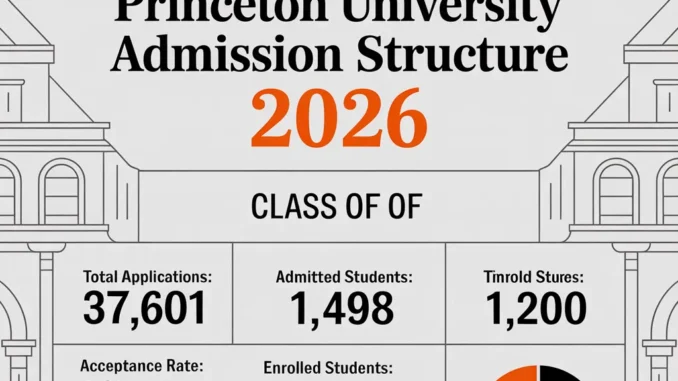
Princeton University is one of the oldest and most prestigious Ivy League institutions in the United States. Known for its academic rigor, world-class faculty, and strong focus on undergraduate education, Princeton attracts talented students from all over the world. Due to its elite reputation, the admission structure of Princeton University is highly selective, holistic, and carefully designed to identify students with exceptional academic ability, leadership potential, and intellectual curiosity.
This article provides a detailed explanation of Princeton University’s admission structure, including eligibility criteria, application components, standardized tests, financial aid policies, and the selection process for both domestic and international students.
Overview of Princeton University Admissions
Princeton University follows a holistic admission process, meaning applicants are evaluated as a whole rather than on grades or test scores alone. The university considers academic achievement, personal character, extracurricular involvement, essays, and recommendations.
One of Princeton’s most distinctive features is its commitment to need-blind admissions and generous financial aid, making it accessible to talented students regardless of financial background.
Levels of Admission at Princeton University
Princeton University offers admissions primarily at two academic levels:
1. Undergraduate Admission
For students applying after completing high school or equivalent education.
2. Graduate Admission
Includes:
- Master’s programs
- Doctoral (PhD) programs
Graduate admissions are handled by individual departments, while undergraduate admissions are managed centrally.
Undergraduate Admission Structure
Application Platforms
Undergraduate applicants can apply to Princeton through:
- Common Application
- Coalition Application
- QuestBridge Application (for eligible low-income students)
Applicants must choose one platform only.
Eligibility Criteria
Princeton does not publish a minimum GPA requirement, but admitted students typically demonstrate:
- Outstanding academic performance
- Strong foundation in mathematics, sciences, humanities, and languages
- Completion of the most rigorous courses available at their school
- High class ranking (often top 5–10%)
International students must hold a secondary school qualification equivalent to a U.S. high school diploma.
Standardized Test Requirements
SAT / ACT
Princeton currently requires SAT or ACT scores for undergraduate applicants.
- Strong emphasis on math and critical reading
- Competitive applicants usually score in the top percentiles
English Language Proficiency
International students whose first language is not English may need to submit:
- TOEFL
- IELTS
- Duolingo English Test
English proficiency is essential for academic success at Princeton.
Academic Transcripts and School Reports
Applicants must submit:
- Official high school transcripts
- Mid-year and final school reports
- Explanation of grading system (for international schools)
Transcripts must be translated into English if originally issued in another language.
Letters of Recommendation
Princeton University requires:
- Two teacher recommendations (preferably from core academic subjects)
- One school counselor recommendation
These letters help Princeton understand the applicant’s intellectual ability, classroom behavior, and personal qualities.
Princeton Essays and Writing Supplements
Essays are a critical part of the Princeton admission structure. Applicants must submit:
- Personal statement
- Short-answer questions
- Graded written paper (mandatory)
The graded paper demonstrates the applicant’s analytical writing and academic readiness.
Princeton values essays that reflect:
- Independent thinking
- Intellectual curiosity
- Personal growth
- Ethical awareness
Extracurricular Activities and Achievements
Princeton looks for depth over quantity in extracurricular involvement. Important areas include:
- Academic competitions
- Research projects
- Community service
- Leadership roles
- Creative arts, sports, or entrepreneurship
The university values students who have made a real impact in their school or community.
Interview Process
Princeton offers optional alumni interviews for many applicants.
Key points about the interview:
- Conducted by Princeton alumni
- Informal and conversational
- Focuses on interests, goals, and experiences
- Not a decisive factor but adds context
Availability depends on geographic location.
Acceptance Rate and Selectivity
Princeton University has one of the lowest acceptance rates in the world, typically around:
- 4%–5% overall
Due to limited seats and high-quality applicants, international acceptance rates may be slightly lower.
Financial Aid Structure
Princeton University is globally recognized for its exceptional financial aid program.
Key Financial Aid Features:
- Need-blind admissions (including international students)
- 100% demonstrated financial need met
- No student loans (grants only)
- Free tuition for families below certain income levels
Financial aid decisions are separate from admission decisions.
Graduate Admission Structure
Graduate admissions at Princeton are department-specific.
Common Requirements:
- Bachelor’s degree from an accredited institution
- Strong academic record
- Letters of recommendation
- Statement of Purpose
- Research experience
- GRE scores (required by some departments)
Most PhD programs offer full funding, including tuition coverage and living stipend.
International Student Visa Process
After admission, international students receive:
- Form I-20 or DS-2019
- Guidance for F-1 or J-1 visa application
Students must:
- Pay SEVIS fee
- Attend U.S. visa interview
- Show proof of financial support
Princeton provides extensive international student support services.
What Princeton Looks for in Applicants
Princeton seeks students who demonstrate:
- Academic excellence
- Integrity and character
- Commitment to service
- Leadership potential
- Passion for learning
The university values students who will contribute positively to the campus community and society.
Tips to Strengthen Your Application
- Take the most challenging courses available
- Develop strong writing skills
- Engage in meaningful extracurriculars
- Show intellectual curiosity beyond textbooks
- Be honest and reflective in essays
Conclusion
The admission structure of Princeton University is rigorous, holistic, and deeply focused on identifying students with exceptional academic ability and strong personal character. With its need-blind policy, generous financial aid, and emphasis on undergraduate education, Princeton remains one of the most sought-after universities in the world.
Leave a Reply