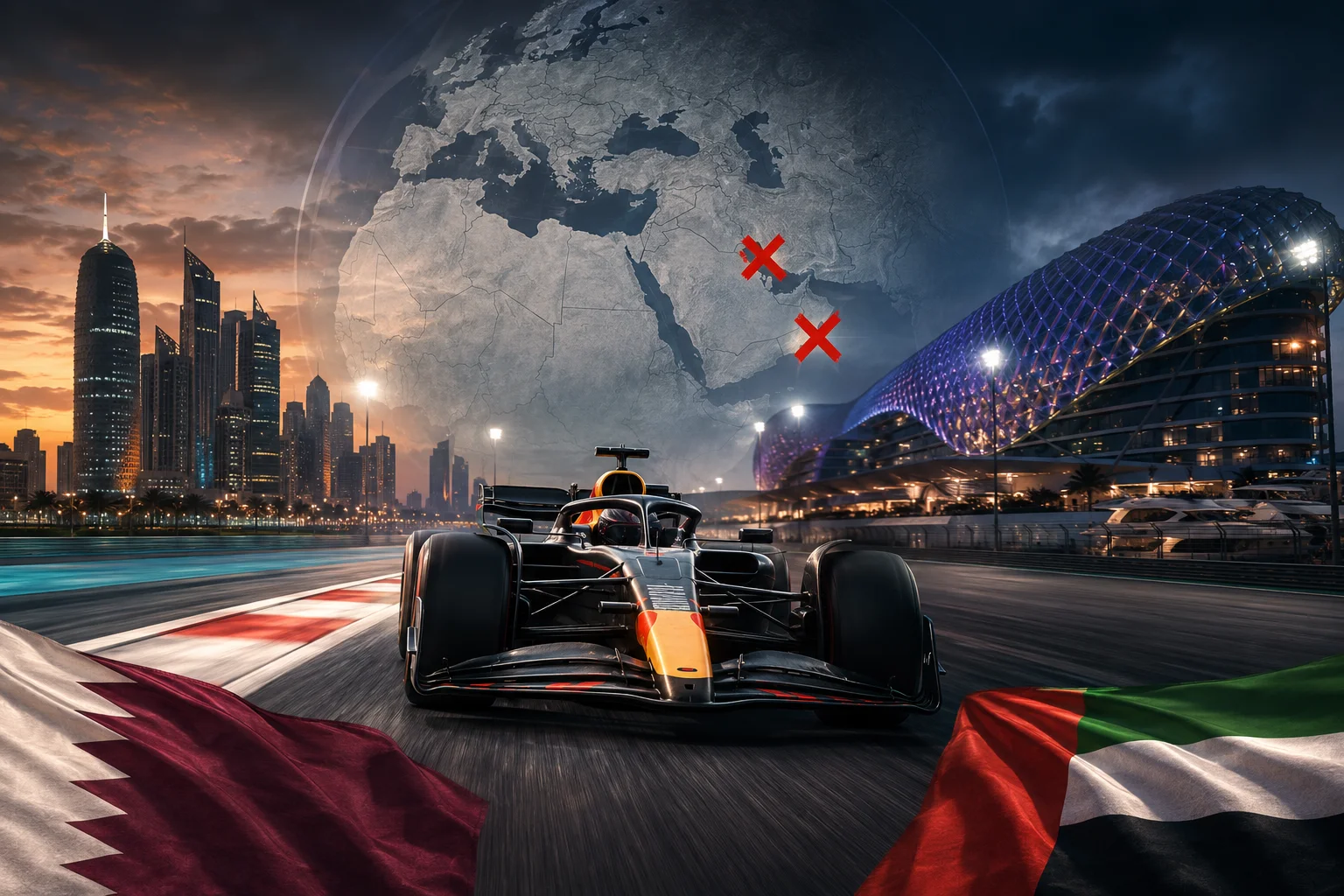
Formula 1 is facing one of its most disruptive scheduling crises in years. War in the Middle East has already wiped two races off the 2026 calendar, and now the sport's season-ending rounds in Qatar and Abu Dhabi are hanging in the balance. F1 chief executive Stefano Domenicali confirmed this week that if those races cannot go ahead, the championship will finish in Europe instead, even if it means racing in the cold.
For a sport that built an entire late-season swing around glamorous Gulf venues, that is a remarkable admission of how serious the situation has become.
Why F1 Cancelled the Bahrain and Saudi Arabia Grands Prix
The trouble started back in February, when a US-Israel war with Iran triggered missile strikes and airstrikes across the Gulf region, hitting locations as close to the paddock as hotels in Manama. With the Bahrain Grand Prix scheduled for April 12 and the Saudi Arabian Grand Prix for April 19, F1 and the FIA had little choice but to pull both events entirely rather than risk the safety of drivers, teams, and fans.
Domenicali called it a difficult but necessary decision at the time, and FIA president Mohammed Ben Sulayem echoed that safety would always come first. Rescheduling both races later in the year was ruled out almost immediately given how packed the calendar already was, leaving Formula 1 to run a reduced 22-round season rather than the record-tying 24 races originally planned.
Bahrain Grand Prix Gets a New Home in Malaysia
In a surprising twist announced this past weekend, F1 confirmed that the Bahrain Grand Prix will return to the 2026 calendar after all, just not in Bahrain. The race has been reassigned to the Sepang International Circuit in Malaysia, with an October 4 date now locked in. Notably, the Gulf kingdom is reportedly covering most of the costs of hosting the replacement event, a sign of how much value Bahrain still places on staying connected to the sport even when it cannot host on home soil.
No replacement has yet been confirmed for the Saudi Arabian Grand Prix, and reporting suggests it is unlikely one will be added this late in the year.
Qatar and Abu Dhabi Still Officially on the Calendar
As things stand, the final two rounds of the 2026 season remain scheduled as planned: the Qatar Grand Prix at Lusail International Circuit on November 27-29, followed by the Abu Dhabi Grand Prix at Yas Marina Circuit on December 4-6. Domenicali was clear that F1 has no intention of pulling either race prematurely.
"For us today, the races in Qatar and Abu Dhabi are confirmed," he told reporters. "By the way, they are already sold out. That is an incredible sign of how much the sport is bigger than the problem that our world is living."
That confidence comes with a hard deadline attached, though. F1 will monitor the situation and make a final call by the middle of September, giving organizers, broadcasters, and travelling teams enough runway to adjust logistics if a switch becomes necessary.
Why Europe, and Why Not Las Vegas
If Qatar and Abu Dhabi do have to be scrapped, Domenicali has ruled out almost every alternative except Europe. He specifically addressed why a second Las Vegas date was not on the table, despite the city already hosting a hugely popular round earlier in November.
"There was a possibility of having two races in Las Vegas, but we don't want to ruin, let me put it this way, a jewel that is growing by undervaluing what we are doing there," he explained. He also pointed to competition from the NFL season, noting that American sports fans' attention is heavily split at that time of year, making it an awkward window to lean further into the US market.
Italy's Imola circuit, dropped from the 2026 calendar entirely this year, has emerged as the strongest candidate to step in. It holds personal significance for Domenicali, who was born nearby, and it is also the home track of Ferrari and current championship contender Kimi Antonelli's Mercedes program. Domenicali has stopped short of confirming Imola outright, calling it "an option, but not defined," while acknowledging cold late-November and early-December weather is a genuine concern for a track not designed around winter racing.
What a European Finale Would Mean for the 2026 Title Fight
A shift to Europe late in the season would be an enormous change for teams used to planning around the heat and long-haul travel of the Gulf swing. Cooler temperatures typically shift tire strategy and car setup windows significantly, which could shake up a championship battle that has already produced surprises this year. Max Verstappen currently sits sixth in the drivers' standings with 109 points, a notably quieter title campaign than fans are used to seeing from the four-time champion, while Red Bull sits fourth in the constructors' table.
Any late scheduling shake-up adds an extra layer of unpredictability to a season that has already been anything but conventional.
What Happens Next
F1 has indicated it is exploring additional options beyond Europe as well, with growing interest from promoters in Africa, Asia, and South America for future seasons, even as the sport works to protect its foothold in newer markets like China. For now, though, all eyes are on the mid-September deadline. Until then, Qatar and Abu Dhabi remain on the books, ticket sales are strong, and Formula 1 is doing everything it can to avoid uprooting its season finale.
Whether the championship wraps up under Gulf lights or amid the chill of a European autumn evening, one thing is clear: 2026 has already reshaped what a modern F1 calendar has to be able to withstand, and the sport's response to this crisis will likely influence how it plans Middle East races for years to come.
For fans trying to plan travel or simply follow the title race to its conclusion, the smartest move right now is to treat the current calendar as provisional rather than final. Ticket holders for Qatar and Abu Dhabi have been given no indication to change their plans yet, but anyone weighing new bookings around those weekends should keep the September deadline firmly in mind. Formula 1 has managed disruption reasonably well so far this season, rerouting an entire Grand Prix to Malaysia rather than simply deleting it, and that same pragmatic approach is likely to define however the Qatar and Abu Dhabi situation ultimately resolves.
Be the first to comment!