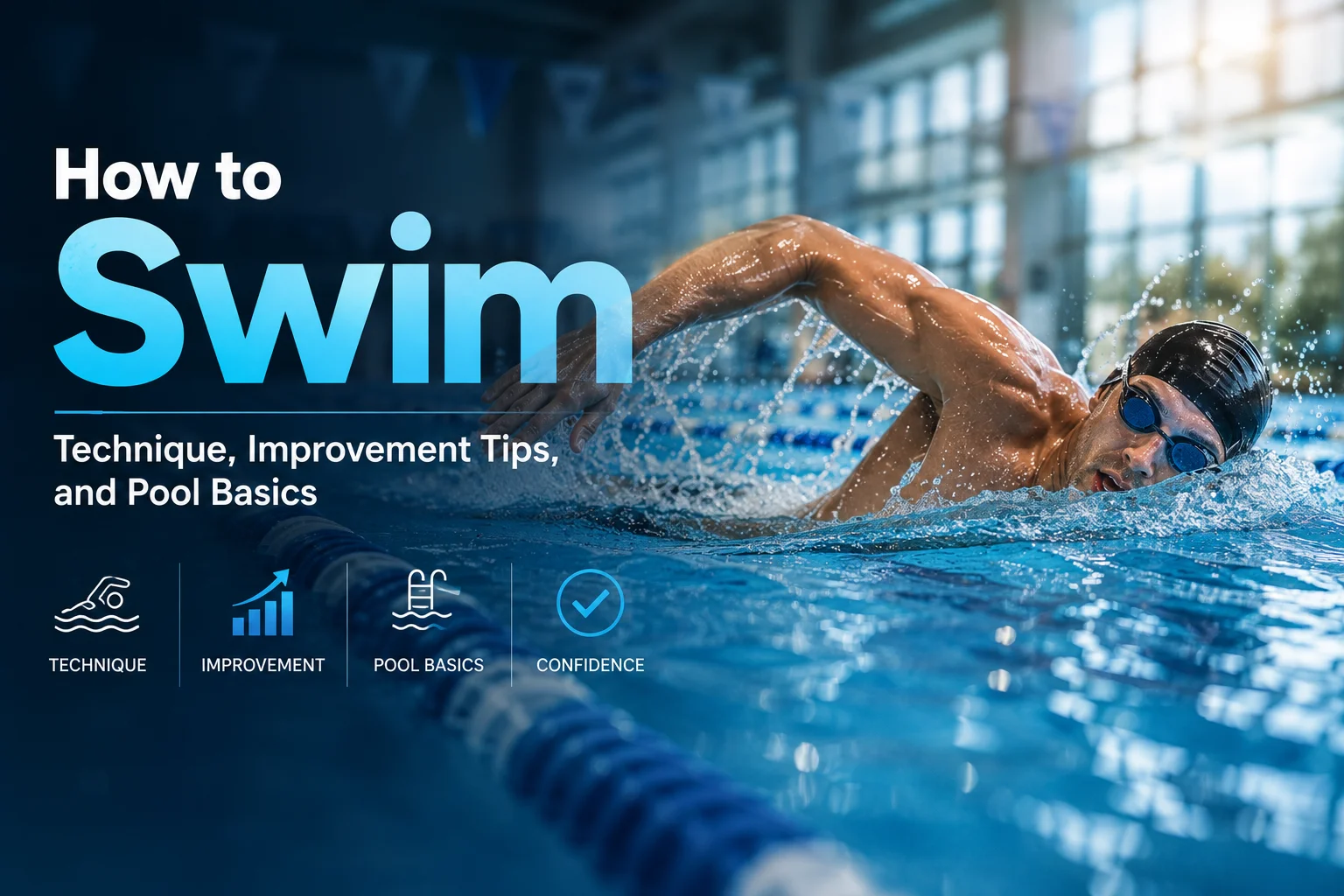
How to Swim: Technique, Improvement Tips, and Pool Basics
Learning to swim is a skill that pays off for life — low-impact fitness, water safety, and access to an entire world of recreation. But between technique questions and pool terminology, getting started can feel more complicated than it needs to be.
This guide covers the fundamentals of learning to swim, how to sharpen technique, and the pool-related basics beginners tend to wonder about.
How to Swim
how to swim
Learning how to swim comes down to building a handful of skills in order, each one supporting the next.
- Get comfortable in the water — walk around in the shallow end and get used to buoyancy before any technique work.
- Learn to float on your back or front to build confidence and reduce panic.
- Practice breathing — controlled exhaling underwater and quick inhaling above the surface.
- Learn basic kicking — a flutter kick from the hips, not the knees.
- Learn arm movements — basic pulling patterns that move you through the water.
- Combine breathing, kicking, and arms. This coordination step is often hardest, and needs repetition.
- Practice basic strokes — freestyle is usually taught first since it's relatively intuitive.
- Build confidence and control through repetition in a safe, shallow environment.
Beginners learn fastest with a qualified swimming instructor who can correct form in real time.
Swimming Fundamentals Every Beginner Should Learn
A few fundamentals show up in every stroke: water confidence, floating and body position, breathing rhythm, kicking mechanics, arm movement and pull, coordination between all of the above, streamlining off the wall, turning, and basic water safety awareness. These are the building blocks every later improvement gets built on.
How to Improve Swimming Technique
how to improve swimming technique
Once the basics are in place, most swimmers plateau not from lack of fitness but from technique that wastes energy. Improving efficiency matters more than swimming harder. Key areas include body alignment (horizontal, streamlined position), head position (eyes down, not lifted), full underwater exhaling so inhales stay quick, a compact hip-driven kick, relaxed high-elbow arm recovery, coordinated stroke timing, a tight streamline off the walls, reduced side-to-side resistance, consistent practice, isolated technique drills, and outside feedback from a coach who can spot habits a swimmer can't feel.
These principles apply to beginners smoothing out first strokes and intermediate swimmers chasing faster times alike.
How to Swim Faster
how to swim faster
Speed comes from combining several elements: better technique and reduced drag, an efficient horizontal body position, purposeful propulsion from arms and legs, breathing that doesn't break stroke rhythm, consistent structured training, and strong turns and push-offs, which account for a surprising share of race time.
A common mistake is assuming harder swimming automatically means faster swimming. A swimmer who thrashes through the water with poor technique often moves slower than a relaxed swimmer with clean form, since poor technique creates drag that eats up the extra effort. Efficiency comes first, power second.
Learning Timeline for Beginners
how many days to learn swimming for adults reddit
Adults searching online — including on forums like Reddit — often want a specific number of days before they'll "know how to swim." The honest answer is there's no universal number that applies to everyone. Progress depends on prior water experience, fear or anxiety around water, how often lessons happen, instruction quality, age and coordination, practice consistency, and whether the goal is basic safety or full stroke proficiency.
Anecdotal online reports vary widely — some describe comfort within a week of daily lessons, others take months. These accounts are useful for perspective but shouldn't be treated as a guaranteed timeline. A structured lesson program with a qualified instructor remains the most reliable path to steady progress.
Swimming Pool Basics
How Long Is an Olympic Swimming Pool?
how long is an olympic swimming pool
An Olympic swimming pool is 50 meters long, 25 meters wide, and at least 2 meters deep, officially regulated by World Aquatics (formerly FINA). This 50-meter length defines "long course" competition, while 25-meter pools are used for "short course" events.
| Pool Type | Typical Length |
|---|---|
| Olympic/long course pool | 50 meters |
| Short-course pool | 25 meters (or 25 yards in the US) |
| Recreational pool | Varies widely, often much shorter |
How Many Swimming Pool Laps in a Mile?
how many swimming pool laps in a mile
This depends entirely on pool length, and the terminology gets confusing. A "length" is one trip across the pool; a "lap" traditionally means a full round trip, though many casual swimmers use "lap" loosely to mean a single length. In a 25-yard pool, a mile (1,760 yards) is roughly 35 laps, or about 70 lengths. In a 25-meter pool, a metric mile is close to 30–32 laps, or roughly 60–64 lengths. Always confirm how your pool defines "lap" before tracking distance.
Swimming for Fitness
How Many Calories Does Swimming Burn?
how many calories does swimming burn
Swimming is widely recognized as an efficient full-body calorie burner, but there's no single number that applies to everyone. Expenditure depends on body size and weight, stroke choice (butterfly and fast freestyle burn more than leisurely swimming), intensity, session duration, individual efficiency, and rest periods. As a general range, many sources estimate an average adult burns roughly 400 to 700 calories per hour of moderate-to-vigorous swimming, with relaxed swimming burning less and high-intensity intervals burning more — estimates, not guarantees, since metabolism and effort vary.
Does Swimming Build Muscle?
does swimming build muscle
Yes, swimming can build and tone muscle, since water provides constant resistance against every movement and engages the whole body simultaneously. Major muscle groups involved include the shoulders and upper back, chest, core, hips, and legs.
It's worth distinguishing muscular endurance from muscle size. Swimming excels at building strength endurance — muscles that sustain repeated effort — but typically doesn't produce the same size increases as heavy resistance training. It's a realistic tool for toning and strengthening the body over time, not a guarantee of major muscle growth or a specific physique.
Swimming Safety and Practical Questions
How Long After Getting a Tattoo Can You Swim?
how long after getting a tattoo can you swim
A fresh tattoo is essentially an open wound, so most tattoo artists and dermatologists recommend waiting roughly two to four weeks before swimming, with some suggesting even longer for larger or more detailed pieces. Pools, oceans, and lakes all carry bacteria that raise infection risk, and chlorine can dry out healing skin and affect ink appearance.
There's no single guaranteed timeline — healing speed depends on tattoo size, placement, individual skin, and how closely aftercare instructions are followed. The safest approach is to follow your artist's specific guidance and wait until the skin is fully healed, with no scabbing, redness, or peeling.
Can You Swim in the Great Salt Lake?
can you swim in the great salt lake
Yes, swimming is possible in parts of the Great Salt Lake in Utah, and it's a genuinely unusual experience. The lake's extremely high salinity makes floating almost effortless, similar to the Dead Sea, but that same salinity can sting cuts, abrasions, or sensitive eyes, and the lake occasionally produces a sulfur-like odor from algae and bacteria.
There are no lifeguards at most access points, so swimming is largely at your own risk, and shallow, changeable conditions make staying near designated areas a sensible precaution. Environmental researchers generally consider the lake water itself safe for casual swimming, though rinsing off with fresh water afterward is recommended.
Swimming Pool Maintenance Basics
How to Increase Alkalinity in a Swimming Pool
how to increase alkalinity in a swimming pool
Total alkalinity buffers a pool's pH, and most guidance recommends keeping it around 80 to 120 parts per million. Low alkalinity destabilizes pH and can cause corrosion or swimmer discomfort. The general process: test the water to find the current level, calculate the right amount of sodium bicarbonate (baking soda) or a commercial increaser based on pool volume, add it gradually while the pump circulates, let it circulate for several hours, then retest before swimming. Always follow product label instructions and avoid combining pool chemicals without understanding how they interact.
How Do You Empty a Swimming Pool?
how do you empty a swimming pool
Draining a pool isn't as simple as running a pump until it's dry. Considerations include local regulations on where drained water can go, the pool's drainage setup and equipment, groundwater conditions (draining in a high water table area can cause structural damage), the type of pool construction (vinyl and fiberglass pools are more vulnerable to shifting or collapsing when empty), and environmental concerns, since chlorinated water can harm plants and waterways if released improperly. Because of these risks, many owners consult a professional before fully draining a pool, particularly older or in-ground ones.
Building a Swimming Pool
How to Build a Natural Swimming Pool
how to build a natural swimming pool
Natural swimming pools use biological filtration instead of chlorine, relying on plants and gravel beds to keep water clean. Basic components include a swimming zone kept separate from the filtration area, a regeneration zone planted with aquatic vegetation, a circulation system moving water between the two zones, biological filtration media like gravel or sand that supports beneficial bacteria, surrounding landscaping, and careful planning, since natural pools need more total space than a conventional pool of the same swimming area. Because they rely on biology rather than chemicals, they require a different maintenance mindset, and construction typically calls for a specialist familiar with these systems.
How Much Does It Cost to Build a Swimming Pool?
how much does it cost to build a swimming pool
Pool construction costs vary enormously by location, size, and materials, so no single price applies everywhere. Conventional in-ground pools commonly range from roughly $35,000 to $120,000, depending on whether the pool is vinyl-lined, fiberglass, or concrete, with concrete typically the most expensive but most customizable. Natural pools tend to run higher, often $50,000 to $150,000, due to the added filtration zone. Beyond the base structure, costs shift with excavation difficulty, filtration and heating systems, landscaping and decking, regional labor rates, permits, and extra features like lighting or diving boards. Anyone budgeting for a pool should get multiple local quotes rather than relying on national averages.
Competitive Swimming
How to Sign Up for a Swim Meet
how to sign up unattcached for a swim meet
Competitive swimming has its own registration system, and understanding the basics helps beginners entering their first meet. In the US, most sanctioned meets fall under USA Swimming or U.S. Masters Swimming, and swimmers register either as part of a club team or as an unattached competitor.
An unattached swimmer competes as an individual without representing a team — common for swimmers between clubs, training independently, or in a required waiting period after transferring. To register as unattached, a swimmer typically needs an active USA Swimming or U.S. Masters membership and selects the "unattached" option during meet entry rather than listing a club. Unattached swimmers can usually compete in individual events but aren't eligible for relays or team scoring.
Because rules differ by governing body and even by meet, swimmers should always check the specific meet's official entry information before registering.
Swimming Curiosity
How Fast a Shark Can Swim
how fast a shark can swim
As a fun tangent for anyone curious about swimming speed in the animal kingdom, sharks vary enormously depending on species. Most large sharks cruise at a leisurely pace of only a mile or two per hour. The shortfin mako, widely considered the fastest shark, is commonly cited with burst speeds in the range of roughly 35 to 45 miles per hour, though some higher estimates exist and scientific measurement of wild shark speed is genuinely difficult, so figures should be treated as estimates rather than precise records. For comparison, even an elite human swimmer tops out at only a fraction of that speed.
Swimming Strokes Beginners Should Know
| Stroke | Main Characteristics | Difficulty for Beginners |
|---|---|---|
| Freestyle | Alternating arms, flutter kick, rotational breathing | Easiest starting stroke |
| Backstroke | Alternating arms, flutter kick, face-up orientation | Moderate — orientation takes practice |
| Breaststroke | Simultaneous pull, whip kick, glide phase | Moderate — timing is tricky |
| Butterfly | Simultaneous arm movement, dolphin kick | Most demanding for beginners |
Freestyle is typically taught first because its coordination demands are the most intuitive. Butterfly, by contrast, requires significant upper-body strength and precise timing, making it better suited for swimmers who already have solid fundamentals.
Common Beginner Swimming Mistakes
- Holding the breath too long instead of exhaling steadily underwater
- Lifting the head too high, which drops the hips and increases drag
- Kicking from the knees instead of the hips
- Crossing the arms over the body's centerline during the pull
- Fighting the water instead of relaxing into proper body position
- Swimming too hard too early instead of building endurance gradually
- Ignoring technique in favor of raw effort
- Practicing inconsistently rather than building steady habits
- Neglecting basic water safety awareness
Most of these mistakes are correctable with focused drills and, ideally, feedback from an instructor who can spot issues a swimmer can't feel from inside the stroke.
Beginner Swimming Practice Plan
- Warm-up with light movement and stretching
- Floating and breathing practice
- Kick practice, often using a kickboard
- Stroke drills isolating specific technique elements
- Short swimming intervals at a comfortable pace
- Rest between sets
- Technique review and correction
- Cool-down with easy, relaxed swimming
Exact training volume should match the swimmer's ability — a beginner might spend an entire session on the first three steps, while a more experienced swimmer moves through the full plan.
Water Safety
Regardless of skill level, a few safety habits matter every time you're in the water:
- Never swim alone when supervision is needed, especially for beginners or in open water
- Follow posted pool rules and lifeguard instructions
- Use appropriate safety equipment, such as flotation devices for non-swimmers
- Know your personal limits and avoid pushing past fatigue
- Avoid risky behavior like diving into unknown depths
- Take formal swimming lessons if you're not yet confident in the water
- Stick to designated swimming areas, particularly in open water settings
Final Thoughts
Learning to swim is a gradual process built on a handful of core fundamentals — comfort in the water, floating, breathing, and coordinated movement — that everything else builds on. Whether the goal is basic water safety, fitness, or eventually competing in a meet, progress comes from consistent practice, attention to technique over raw effort, and realistic expectations about timelines and results. Pool basics, safety knowledge, and a bit of curiosity about the sport round out what every beginner should know before diving in.
Be the first to comment!