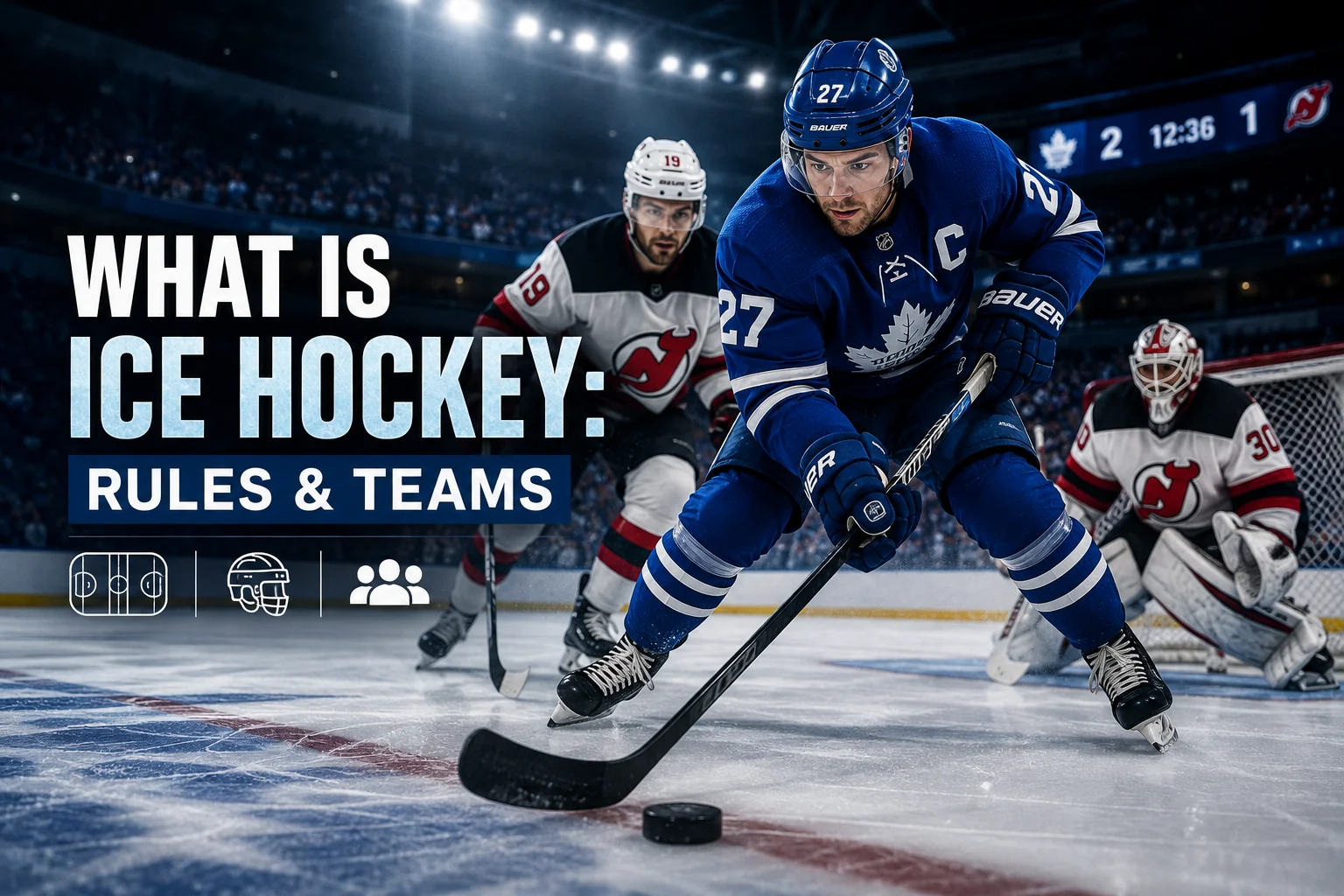
Ice hockey is a fast-paced contact sport played on a frozen rink, where two teams use curved sticks to shoot a rubber puck into the opposing goal, trying to outscore each other over three periods. Play switches constantly between offense and defense, and the game is known for its speed, physical contact, and shots that can top 90 miles per hour.
History and Origins of Ice Hockey
Ice hockey's roots are murky, with stick-and-ball games played on ice in Canada dating back to the early 1800s, influenced by field sports like hurling and bandy. The sport took a major step toward its modern form on March 3, 1875, when the first recorded indoor game was played at Montreal's Victoria Skating Rink, introducing a flat wooden disc — an early version of today's puck — in place of a ball. Two years later, formalized rules known as the Montreal Rules were published, and the McGill University Hockey Club became the first organized team. The Stanley Cup followed in 1893, the NHL formed in 1917 with four original Canadian teams, and ice hockey became an Olympic sport in 1920, growing into one of the most popular team sports in North America and Europe.
Who Invented Hockey?
The question of who invented hockey doesn't have a single, tidy answer — the sport evolved gradually from earlier stick-and-ball games rather than being created by one person. That said, James Creighton, the engineer who organized the landmark 1875 Montreal game and helped publish the first formal rules two years later, is widely regarded as a central figure in shaping organized hockey, often called a father of modern hockey rather than its sole inventor.
Teams and Player Positions
Each team fields six players on the ice at a time: three forwards (a center and two wings), two defensemen, and one goaltender. The center leads offensive plays and takes faceoffs, the wings support scoring chances along the sides, the defensemen protect the defensive zone and start rushes, and the goaltender defends the net.
How Many Players on a Hockey Team?
While six skaters per side are on the ice at once, full rosters are larger — NHL teams can dress a maximum of 20 players for a game, typically 18 skaters and 2 goaltenders, substituting frequently through "line changes" to keep skaters fresh.
The Hockey Rink, Boundaries, and Goals
An NHL rink measures 200 feet long by 85 feet wide, surrounded by boards and protective glass. The ice is divided into three zones: the defensive zone, closest to a team's own goal; the neutral zone, between the two blue lines; and the offensive zone, closest to the opponent's goal. Key markings include the center red line, two blue lines, goal lines, and faceoff circles used to restart play. Each goal is a netted frame set into the ice, with a crease around it protecting the goaltender under special rules.
How Goals Are Scored
A goal is scored when the puck fully crosses the goal line and enters the net. Any player except the goaltender may shoot or redirect it in, with each goal worth one point — the team with more goals at the end of play wins.
Periods and Game Structure
How Many Periods in Hockey?
Ice hockey is played in three periods, not quarters or halves. Each period runs 20 minutes of playing time, with the clock stopping for whistles, penalties, and other stoppages.
How Many Quarters in Hockey? How Many Halves in Hockey? How Many Innings in Hockey?
Ice hockey uses none of these. Quarters belong to basketball and football, halves belong to soccer, and innings belong to baseball — hockey is built around three 20-minute periods, separated by intermissions.
How Long Is a Hockey Game?
At the professional level, three 20-minute periods add up to 60 minutes of playing time. So how long is a typical hockey game in real-world terms? Once you factor in stoppages for penalties, timeouts, and TV breaks, most NHL games run about two and a half hours — roughly how long is a hockey game usually for fans watching at home or in the arena.
Overtime and Game-Ending Rules
If an NHL regular-season game is tied after regulation, it moves to a five-minute, 3-on-3 sudden-death overtime, followed by a shootout if still tied. Playoff games differ — tied games go to full 20-minute sudden-death overtime periods at standard strength until someone scores, with no shootout.
Common Penalties and Violations
Referees enforce penalties to keep the game fair and safe, including tripping, slashing, high-sticking, and roughing. Most penalties send the offending player to the penalty box, where their team plays "short-handed," giving the opponent a power play.
What Is Boarding in Hockey?
Boarding is called when a player checks or hits an opponent violently into the boards, especially when that opponent can't protect themselves. It carries injury risk and can range from a two-minute penalty to a full ejection.
Icing
What Is Icing Ice Hockey?
Icing occurs when a player shoots the puck from their own side of the center red line all the way across the opponent's goal line without it being touched, and an opposing player other than the goaltender reaches it first. Play stops for a faceoff in the offending team's defensive zone. In simple terms, what does icing mean in hockey is that a team tried to clear the puck the length of the ice to relieve pressure — the rule stops teams from firing the puck away without consequence, forcing more strategic puck movement.
Forechecking
What Is Forechecking in Ice Hockey?
Forechecking is an offensive strategy where players pressure the opposing team in their own defensive zone to disrupt the breakout and force a turnover — a tactic that can pin an opponent in their own zone and lead directly to scoring chances.
Types of Shots in Ice Hockey
What Are the Different Types of Shots in Ice Hockey?
Players use several shooting techniques suited to different situations: the wrist shot, a quick, accurate release generated by snapping the wrists; the slap shot, a powerful shot with a full wind-up, often from farther out; the snap shot, a hybrid of the two offering a quick release with extra power; the backhand shot, taken off the back of the stick blade; and the one-timer, a shot taken directly off a pass without stopping the puck first.
Hat Tricks
What Is a Hat Trick in Ice Hockey?
A hat trick happens when a single player scores three goals in one game — one of the sport's most celebrated individual feats, and at many arenas fans throw their hats onto the ice to mark one.
Frequently Asked Questions
Who invented hockey?
No single person invented hockey — it evolved from earlier stick-and-ball games on ice, though James Creighton is widely credited with organizing the first formal game and rules in Montreal in 1875.
How long does a hockey game usually last?
The game clock runs for 60 minutes across three periods, but stoppages typically stretch a real-world NHL game to around two and a half hours
Be the first to comment!